

Health, Climate, Democracy:
An Indivisible Agenda
Why climate resilience in Latin America & the Caribbean depends on health equity — and why health equity depends on democratic governance.
I. Strategic Positioning
BVI approaches the climate crisis as, first and foremost, a crisis of governance. Public health and human rights are not adjacent concerns to climate action — they are the terrain on which climate action succeeds or fails. Consistent with its institutional mission, BVI works at the intersection of three inseparable axes:
- Public health as a fundamental right and a site of structural inequality. The right to health obligates states to protect, respect, and fulfill it — an obligation that extends to the basic necessities, food, water, and shelter, without which no health system can function.
- Climate justice as a struggle over territory, resources, and survival. Rural and marginalized communities absorb the first and worst effects of climate change. Indigenous peoples in the Amazon and other remote territories act as de facto custodians of the land and biodiversity they protect, even as deforestation, territorial dispossession, and internal displacement strip away their water, homes, and livelihoods.
- Democracy as the mechanism through which climate and health responses earn public trust. Structured opportunities for public participation strengthen political equality and ensure that government action reflects the interests of the people it is meant to serve. Decolonized capacity-building and the elevation of youth and civil-society voices are not symbolic gestures — they are what makes participation mechanisms real rather than performative.
1.1 — What This Looks Like on the Ground in the LAC Region
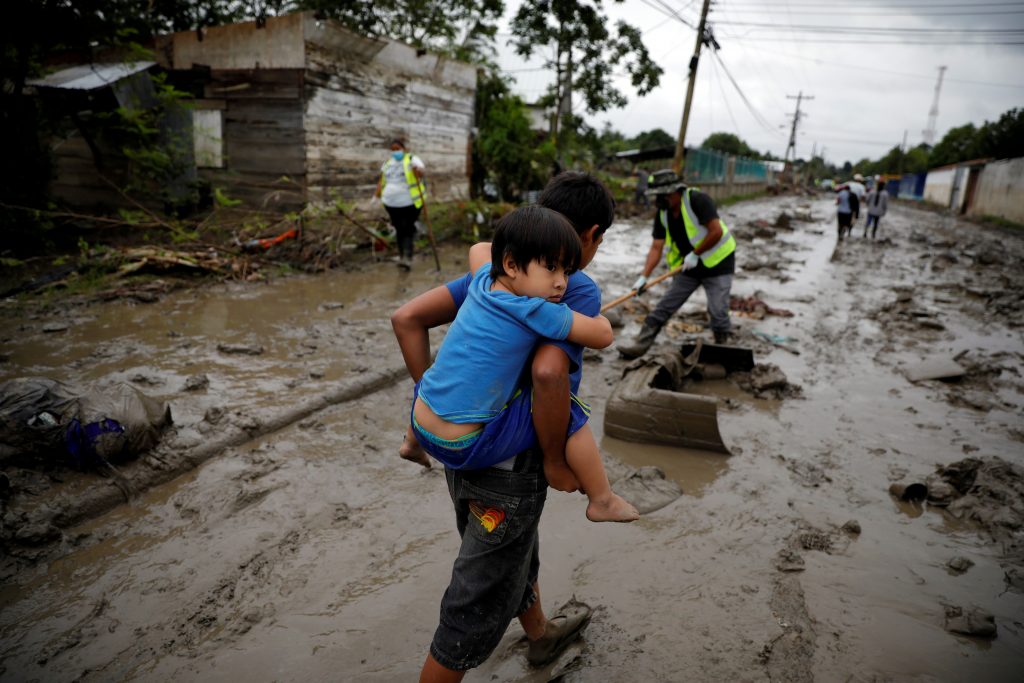
Across Latin America and the Caribbean, communities facing floods, droughts, extractive industries, and forced displacement do not experience climate change as a single disaster. They experience its compounding effects across every part of daily life:
- Disruption of health services. Clinics lose water, electricity, and supply chains; disasters destroy the facilities themselves and cut off the roads that would otherwise bring in food and medicine.
- Heightened exposure to gender-based violence. Climate stress intensifies the conditions that put women at risk — scarce resources, disaster displacement, and the collapse of rural livelihoods. When displacement forces women into temporary shelters or homelessness, it places them within reach of traffickers and exploiters; when water or food insecurity forces them to travel farther, the same risk follows them.
- Reduced access to sexual and reproductive health services, through the loss of contraception supply, unsafe conditions for surgical procedures and births, and broken supply chains for essential care.
- Systematic exclusion from decision-making. Marginalized communities are the last to receive relief and the last considered in disaster preparedness and response planning — not incidentally, but structurally.
«There can be no climate resilience without health equity, and no health equity without democratic governance».Catherine Martinez, MPH · Regional Coordinator, North America & LAC · Bastion Vert International
II. Evidence from LAC: Climate Change and Adolescent SRHR
BVI's position is grounded in regional evidence, including research led by the Pan American Health Organization (PAHO) and New York University on the intersection of climate change and adolescent sexual and reproductive health (ASRH) in Latin America and the Caribbean.
2.1 — Climate Change as a Risk Multiplier
Climate change does not create new inequities so much as it exacerbates the ones that already exist. The documented pathways include:
- Food and water insecurity, driven by contaminated water, weak water infrastructure, and climate-linked damage such as erosion, chronic flooding, and hurricanes.
- Deepening economic vulnerability and dependency.
- Displacement that heightens the risk of gender-based violence and exploitation.
- Climate-driven disruption of health systems, limiting access to contraception and maternal care.
Adolescents bear a disproportionate share of these impacts — girls, Indigenous youth, Afro-descendant populations, and LGBTQ+ individuals most of all. The consequences include higher rates of adolescent pregnancy alongside reduced access to contraception and SRHR services, heightened exposure to gender-based violence, and the long-term educational and economic costs of climate-related school disruption. A growing body of global and regional research confirms the pattern: climate stressors intensify pre-existing gender and health inequities rather than operating apart from them.
2.2 — Regional Practice and Policy Gaps
Where PAHO and its partners have supported integrated, multisectoral approaches connecting health, education, and social protection, adolescent health outcomes improve — proof that workable models already exist and can be adapted at scale. But critical gaps persist:
- Climate policy remains largely disconnected from health-system planning.
- Youth participation is too often reduced to tokenism and consultation rather than decision-making authority. Multilateral organizations can change this by establishing structured, meaningful engagement mechanisms — youth advisory councils, participatory policy forums — that actually shape outcomes.
- Data systems lack the disaggregation needed to identify intersectional vulnerabilities.
- These gaps are not a capacity problem. They are a governance failure — one that clear metrics and accountability mechanisms could correct, if the political will existed to track them.

III. The Core Challenge: A Governance Deficit
Current health and climate responses fall short not primarily because of limited capacity, but because of a governance deficit. Closing it requires practical, rights-based strategies that treat these challenges as interconnected rather than sector by sector.
BVI identifies five systemic failures — all sharing a common root: treating affected populations as policy beneficiaries rather than political actors.
Fragmentation across the climate, health, and gender sectors limits sustainable development and resilience, preventing the integrated responses these crises demand.
Youth and other marginalized groups are systematically excluded from the decisions that directly affect them — structurally, not incidentally.
Financing mechanisms do not prioritize health outcomes, leaving frontline communities and SRHR services outside the scope of climate funding.
Insufficient disaggregation by age, gender, ethnicity, and geography limits the ability to identify intersectional vulnerabilities and design effective responses.
Without enforceable standards and monitoring systems, commitments remain rhetorical rather than structural, and communities absorb the cost.
BVI rejects the beneficiary model. In its place, BVI promotes a rights-based approach in which communities and governing institutions work as partners — driving concrete policy change and institutional reform together, rather than one acting upon the other.
IV. BVI Framework: Health–Climate–Democracy Integration
BVI proposes an integrated, rights-based framework built on three operating principles.
Health outcomes — particularly access to sexual and reproductive health services — must be treated as central indicators of climate impact, alongside supply-chain disruption, disease transmission, resource scarcity, and job loss. Preterm birth, stillbirth, and child marriage are climate indicators as much as they are health indicators.
Adolescents and young people must be recognized as rights-holders and decision-makers, with institutionalized roles in governance — not consulted after decisions are made, but present when they are made.
Effective climate adaptation requires transparency in institutional operations, participatory governance mechanisms, and enforceable accountability systems. Without them, climate policy risks reinforcing the inequalities it claims to address.

V. Policy Recommendations for Multilateral Institutions
BVI calls on multilateral actors — including PAHO, UNFPA, the World Bank, and global climate funds — to work with civil society to integrate the following strategies into their programs and policies.
Multilateral climate funds — the Green Climate Fund, Strategic Climate Fund, Climate Investment Funds, and Adaptation Fund — should mandate the inclusion of health services, including SRHR, in adaptation projects and establish dedicated funding streams for climate-health-gender programming with youth- and gender-responsive indicators. This means funds earmarked for frontline services: nutrition, medication, clinics, sustainable energy, and mobile SRH services — alongside targeted investment in women's employment in green jobs, renewable energy, and STEM, and disaster-response plans that build in gender-inclusive shelters, emergency housing funds, and safety hotlines from the start.
Rationale: Current climate financing frameworks largely exclude SRHR despite its centrality to resilience and equity.
Support national governments to integrate ASRH into National Adaptation Plans (NAPs), strengthen climate-resilient primary health care, and ensure continuity of services through climate-related emergencies.
Rationale: Health-system resilience is foundational to effective climate adaptation.
Fund longitudinal research on the long-term health effects of climate change in LAC; require disaggregation by age, gender, ethnicity, and geography; and strengthen regional surveillance systems, including those led by PAHO, to catch and respond to emerging risks earlier.
Rationale: Data gaps obscure inequities and limit how precisely policy can be targeted.
Establish formal, intentional mechanisms for youth participation in decision-making bodies and high-level meetings, building on frameworks like ECOSOC. Fund youth-led organizations directly and sustainably — not through one-off seed grants, but through frameworks built for long-term advocacy, education, and community engagement — and integrate youth into UNFCCC and global health governance processes.
Rationale: Meaningful youth engagement produces policy that is more relevant, effective, and accountable.
Integrate SRHR and gender-based violence prevention into climate policy; align climate commitments with international human rights obligations; and establish monitoring systems that track rights-based outcomes, not just emissions or funding disbursed.
Rationale: Climate change is fundamentally a human rights issue, and it requires governance approaches that treat it as one.
VI. BVI's Role: A Bridge Actor for Systemic Change
BVI works to connect what too often stays disconnected: territorial realities and multilateral policy spaces, scientific evidence and political advocacy, youth leadership and institutional decision-making. Its role is to translate lived experience into actionable policy frameworks — not to speak for communities, but to make sure the systems that govern them can hear what they are already saying.
VII. Conclusion
BVI advocates for health to be built into the foundation of climate policy — not added to it after the fact — so that climate action can be redefined as a matter of public health, territorial justice, and democratic power, shaped through genuine community consultation and buy-in.
«Who defines adaptation? Whose health is protected? Whose rights are upheld?»Bastion Vert International · BVI Advocacy Lines · September 16 2026

Health, Climate, Democracy: An Indivisible Agenda
↓ Download Full Document (PDF)References
- UNFPA. (2021). The impact of the climate crisis on sexual and reproductive health and rights. esaro.unfpa.org
- UNFPA. (2022, June). UNFPA report finds sexual and reproductive health of women and girls missing from most national climate plans. unfpa.org
- UN Women LAC. (n.d.). The state of women & COVID-19 in Latin America and the Caribbean: Rapid gender analysis. lac.unwomen.org
- World Health Organization. (2023). Climate change. who.int
- UNICEF. (n.d.). Spotlight Initiative Caribbean regional programme. unicef.org
- Pan American Health Organization. (n.d.). Climate change and health: Vulnerability and adaptation assessment. paho.org
- UNFCCC. (2025, September 2). Inclusive participation and strong institutions key to advancing adaptation and resilience. unfccc.int
- Climate Investment Funds. (2023). Green jobs for women: The role of climate finance. cif.org
- OHCHR. (2025). Human rights mechanisms addressing climate change. ohchr.org